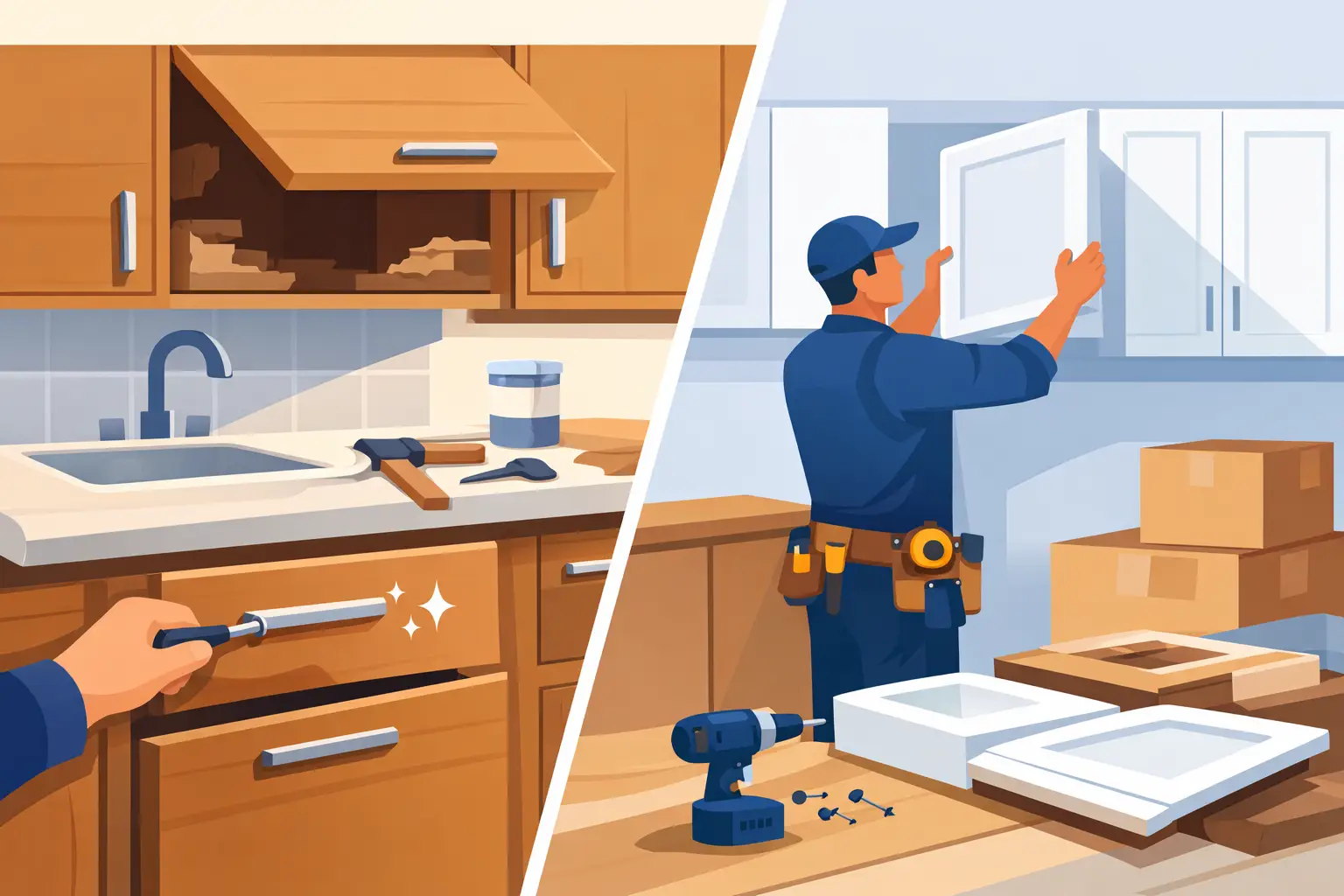
That swollen cabinet base under the kitchen sink usually tells the truth before any contractor does. If only one section is rotten, the real question is not whether your whole kitchen is finished. It is partial cabinet repair vs replacement, and choosing wrongly can cost you far more than the damage itself.
In Singapore homes, this decision comes up all the time. A small leak from the water tap, bottle trap, angle valve or sink seal slowly soaks the cabinet floorboard. In HDB flats and Condo units, the damage often stays localised to the sink base, side panel, back panel or plinth. Yet some owners are still told to hack out and rebuild the entire lower cabinet run. Sometimes that is necessary. Many times, it is not.
Partial cabinet repair vs replacement – what is the real difference?
Partial repair means removing and rebuilding only the affected cabinet parts. That may be the base panel, one side panel, the back panel, skirting, shelf, hinge area or a small section of carcass that has already softened from water damage. The unaffected doors, drawers, top sections and adjacent cabinets stay in place.
Replacement means taking out the full cabinet unit, and in some cases multiple connected cabinets, then fabricating and installing new sections to match or redesign the kitchen layout. This is a bigger job, with more dust, more coordination and usually more cost.
The right choice depends on three things – how far the damage has spread, whether the cabinet structure is still sound, and whether a matching repair can be done cleanly. A proper assessment is not about selling the biggest job. It is about checking exactly where the board has failed and where it has not.
When partial cabinet repair makes more sense
Most under-sink cabinet damage starts small. In Singapore’s humidity, chipboard and laminate do not forgive repeated moisture. Once water gets into exposed edges, the board swells, loses strength and starts to crumble. But that does not automatically mean the whole cabinet line must go.
A partial repair is usually the smarter option when the damage is limited to one zone. This often happens when the leak has stayed around the pipe cut-out, the baseboard directly below the sink, or one cabinet side nearest the plumbing. If the surrounding cabinet panels remain dry, square and solid, there is no practical reason to throw away everything else.
This matters even more in occupied homes. Families do not want their kitchen torn apart for days if a focused repair can solve the problem. Landlords want a rentable unit again quickly. Property agents handling handovers need something presentable and dependable without triggering a mini renovation. In these situations, fractional carpentry repair saves both money and downtime.
There is also a local practical point. In many HDB kitchens, cabinet runs are built tight to walls, service points and kitchen tops. Full replacement can turn a simple cabinet problem into a coordination issue involving plumbing disconnection, sealing work, debris removal and possible colour mismatch across the kitchen. If only one damaged section needs rebuilding, keeping the rest intact is often the cleaner decision.
When full replacement is the better call
Not every cabinet can or should be rescued. If the water damage has spread across several connected carcass sections, the board has collapsed at multiple load points, or termites and rot have already compromised the structure, replacement may be the safer route.
The same applies when previous patch jobs have failed. If the cabinet has already been repaired badly, with swollen layers hidden under laminate or loose internal supports, another partial fix may simply delay the problem. You spend once, then spend again.
Full replacement is also more sensible when the existing cabinet material is too degraded to hold hinges, shelves or new fixings securely. If the doors no longer align because the frame itself has distorted, or the cabinet has started affecting the sink support area, targeted repairs may not give a lasting result.
Then there is the finish issue. Some older kitchens use laminates, edging or profiles that are no longer easy to match. If appearance matters and a visible patch would look obviously different, replacement can be the better aesthetic choice. That is especially relevant in private properties being prepared for sale or tenancy, where presentation affects value.
The hidden cost question most owners miss
People usually focus on the quoted price. Fair enough. But the real cost of partial cabinet repair vs replacement also includes disruption, follow-up trades and the risk of doing too much or too little.
A full replacement may look tidy on paper, but it often pulls in extra work. Plumbing disconnection and reinstatement, silicone resealing, haulage, access timing, Condo management rules and disposal all add up. In some buildings, MCST guidelines on work hours and debris movement can stretch a one-day idea into a much longer process.
On the other side, the cheapest patch is not always the smartest repair. If the leak source is not fixed first, even a new cabinet base will fail again. If the damaged area is wider than it looks, covering it up instead of cutting out the rotten board just wastes your money.
This is where transparent assessment matters. You want someone willing to say, clearly, this can be repaired safely, or no, this one is beyond a sensible repair. Anything else is guesswork dressed up as confidence.
How cabinet damage is assessed properly in Singapore homes
A proper site assessment is straightforward. First, the leak source must be identified. It may be the water tap connection, waste pipe, bottle trap, sink rim, flexible hose or even condensation from poor ventilation. Repairing wood without stopping the moisture source is pointless.
Next, the affected panels are checked physically. Swelling, softness, delamination, mould smell, dark staining and screw pull-out all tell you how deep the damage goes. In many sink cabinets, the visible damage is at the floorboard, but the side panel bottoms and back panel edges may already be weakened too.
Then the surrounding structure is considered. In HDB and Condo units, cabinetry is often built around fixed plumbing points and close tolerances. A targeted rebuild has to work with the existing kitchen top, doors and nearby panels. The repair is only worth doing if the final result is stable, usable and visually acceptable.
This is also the stage where honest advice matters most. Some clients expect replacement when a partial rebuild will do. Others hope for a cheap repair when the carcass is already too far gone. The right answer is not always what people expect, but it should always be explained plainly.
Partial cabinet repair vs replacement for different property types
In HDB flats, partial repair is often highly practical because kitchens are compact and the damage is usually concentrated under one sink base. Owners typically want a fast turnaround, controlled mess and no unnecessary hacking. If the cabinet line around the damaged section remains sound, a localised repair makes financial sense.
In Condo units, access and management restrictions can influence the decision. If lift protection booking, disposal timing and work-hour limits make larger works inconvenient, a precise repair can avoid a lot of hassle. But if the unit is being refreshed for sale or rental and matching is critical, replacement may still be worth it.
In landed properties, there is often more variation. Some older homes have repeated moisture issues, older carpentry materials or larger cabinet runs where damage has travelled further than expected. Here, the decision is less about property type and more about the actual condition of the cabinet structure.
What you should do before approving any cabinet work
Ask what exactly is being replaced, what is being retained, and why. If a contractor says full replacement is necessary, ask which panels have failed structurally. If partial repair is proposed, ask how the new section will be tied into the existing cabinet and whether the leak source is included or must be fixed separately.
You should also ask about finishing expectations. A sound repair is the priority, but appearance matters too. Some repairs can be matched closely. Some will be neat but not invisible. Better to know that upfront than argue after installation.
Most importantly, do not approve carpentry based on fear. Swollen board looks awful, but ugly does not always mean total replacement. Equally, a cabinet that still looks passable from outside may already be too weak inside for a proper repair. The job should match the damage, not the sales pitch.
For homeowners and managers in Singapore, the smartest move is usually simple – send clear photos first, especially of the sink base, side panels, plinth area and plumbing. A good handyman or carpentry repair specialist can often tell from the photos whether your issue likely suits a fractional repair or needs a fuller rebuild, then confirm on site with a transparent quote and no nonsense.
If your sink cabinet is swollen, soft, mouldy or collapsing, do not wait for the damage to spread into the next panel. Send photos on WhatsApp and ask for a clear assessment of partial cabinet repair vs replacement, the exact scope, and the real cost before work starts. That one honest answer can save you a full renovation bill you never needed.

0 Comments