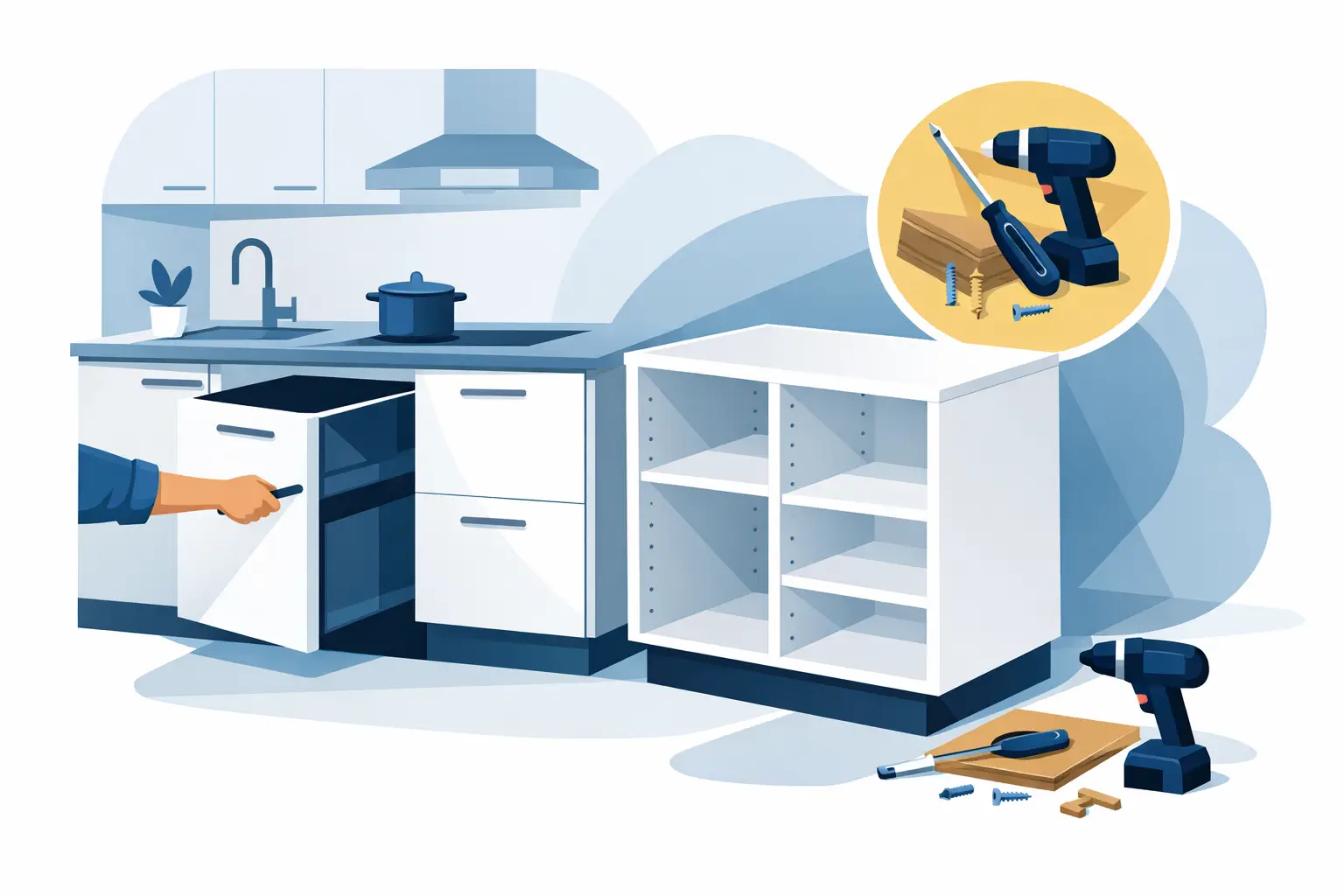
A leaking sink cabinet usually does not destroy your whole kitchen. What it destroys first is one section – the base panel, side gable, backboard, plinth, or shelf nearest the leak. That is why kitchen carcass section replacement makes sense for many Singapore homes. If the doors, hinges, kitchen top, and most of the cabinet body are still sound, replacing only the damaged carcass section is often the smartest and cheapest fix.
In Singapore, this problem shows up again and again under the sink, beside the dishwasher space, near concealed pipe joints, and along floor-level plinth areas where mopping water sits too long. HDB flats, Condo units, and landed homes all get it. The difference is not the property type. The difference is how quickly the leak is caught, and whether the repair is done properly before the rot spreads.
When kitchen carcass section replacement is the right fix
A lot of owners assume swollen chipboard means full cabinet replacement. That is simply not true. In many kitchens, the damage is localised. The cabinet doors may still align well, the kitchen top may be stable, and the adjoining carcass sections may still be dry and structurally firm. In that case, cutting out the affected section and rebuilding only that area can save a substantial amount.
This is especially common for sink-base cabinets. The water tap connection may drip slowly for months. A bottle trap may sweat. Silicone around the sink edge may fail. By the time the owner notices the smell or soft wood, one lower section is already bloated. But the rest of the run can still be usable.
A proper assessment matters here. If the side panels have turned powdery, the screw holding strength is gone, or the moisture has travelled across several adjoining units, section replacement may no longer be enough. Honest advice matters more than a cheap promise. Sometimes a partial repair is a very good solution. Sometimes it only delays a larger problem by six months.
What usually gets damaged in Singapore kitchens
Most local kitchen cabinets are made with melamine-faced chipboard or similar engineered board. It keeps costs sensible, but it does not forgive long-term water exposure. Once moisture enters through unsealed edges, cut-outs, screw holes, or peeled laminate, the board swells and loses shape.
The most common failures are the sink-base floor panel, one side panel near the pipe entry point, the rear panel, and the front kickboard or plinth. In older flats, you may also see rusted leg supports, loose hinge mounting areas, and mould growth trapped in dark corners. In newer BTO kitchens, the issue can start earlier than owners expect if the original sealing around plumbing cut-outs was poor.
Humidity also makes things worse. Even without a major leak, a damp cabinet interior in Singapore can stay wet far too long. Once the board starts to expand, doors stop closing properly, shelves dip, and the entire section feels soft under hand pressure.
How kitchen carcass section replacement is actually done
This is not just a matter of covering damaged wood with laminate and hoping for the best. Good kitchen carcass section replacement starts with finding and stopping the water source first. If the leak is still active, any carpentry repair will fail.
After that, the damaged sections are measured carefully. The affected panels are removed without disturbing healthy adjoining units more than necessary. This is where experience matters. In HDB and Condo kitchens, cabinet runs are often tight against tiled walls, solid walls, washing machine spaces, or built-in appliances. A careless dismantling job creates more damage than the original leak.
The replacement boards are then fabricated to match the existing carcass dimensions as closely as possible. Depending on the condition, this may involve replacing one side panel, the bottom base, the backboard, or a combination. New support framing may be added where the old board has lost screw grip. Exposed edges should be sealed properly, especially around pipe penetrations and floor-level contact points.
If the plinth is also swollen, it should be replaced at the same time. Leaving a rotten plinth below a newly repaired cabinet section makes little sense. The same goes for heavily rusted hinges or screws. A proper repair looks at the whole affected zone, not just one visible board.
The cost advantage over full cabinet replacement
This is the part most homeowners care about, and rightly so. Full kitchen replacement in Singapore is expensive, messy, and slow. Once you involve a renovation contractor, hacking risk, coordination delays, and matching issues come into play. For one rotten sink cabinet, that is often overkill.
Kitchen carcass section replacement works because it targets the failed area only. You keep the usable doors, keep the existing kitchen top if it is still sound, and avoid redoing the entire layout. For landlords preparing a unit for handover, for families who cannot live without the kitchen for a week, and for owners who simply do not want to pour thousands into one damaged section, this approach is usually the practical answer.
There is a trade-off, though. A sectional repair is not a brand-new full kitchen. Colour and laminate matching can be close, but not always perfect, especially for older cabinets with faded finishes or discontinued patterns. Most customers accept that because the goal is functional restoration, cost control, and clean appearance – not a luxury showroom rebuild.
HDB, Condo, and landed property realities
Local experience matters more than many people realise. In HDB flats, kitchen layouts are often compact, with service yard access, pipe chases, and limited working room. Some owners also confuse cabinet deterioration with defects that belong to other parties. If the issue is caused by an internal cabinet leak or owner-installed fitting failure, it is usually the owner’s responsibility, not the town council’s.
In Condo units, access and management rules can affect scheduling. Some MCSTs restrict work timing, lift protection, or disposal arrangements. A repair team that understands these practical issues can plan the job with less disruption.
For landed properties, the challenge is often older carpentry with non-standard dimensions. Section replacement is still possible, but the fabrication may be more customised. The upside is that older solid units can sometimes be repaired more effectively because not everything is factory-standard modular board.
When partial repair is not enough
Not every cabinet should be saved. If termite damage is present, if the cabinet run has widespread black mould, if the sink support has become unsafe, or if the kitchen top is no longer properly supported, a larger rebuild may be the safer route. The same applies when multiple sections have already failed and the remaining boards are only waiting their turn.
This is where straightforward advice matters. A good repair specialist should tell you clearly whether sectional replacement is worth doing or whether your money is better spent on a larger replacement. There is no benefit in patching three weak sections just to call someone back again shortly after.
What to do before the damage spreads
If you notice a musty smell under the sink, bubbling laminate, soft flooring inside the cabinet, rust stains, or doors rubbing strangely, do not wait. Empty the cabinet, dry the area, and check the bottle trap, water tap hoses, angle valves, and sink rim sealing. Even a slow drip can do serious damage over time.
Take clear photos of the inside base, both side panels, the pipe area, and the cabinet exterior. If possible, include one wider photo showing the whole kitchen section and one close-up showing the swelling or rot. That makes it much easier to assess whether kitchen carcass section replacement is likely to work before a site visit.
If you are a landlord or agent managing a handover, act early. A damaged sink cabinet gets flagged fast during inspection, and it creates the impression that the whole unit has been neglected. A targeted repair is usually quicker and more cost-effective than trying to explain away rotten carpentry.
A practical fix, not a sales trick
There is nothing glamorous about replacing one rotten cabinet section. It is simply sensible when the rest of the kitchen is still serviceable. That is why many owners across Singapore choose partial carpentry restoration instead of being pushed into a full renovation bill they do not need.
If your sink cabinet is swollen, soft, or already crumbling, send photos on WhatsApp first. A clear assessment, transparent pricing, and an honest answer on whether sectional repair is viable will save you time, money, and a lot of unnecessary disruption. HRD Professional Handyman handles this type of fractional kitchen repair every week, and if a kitchen carcass section replacement can solve the problem properly, you should be told that upfront.
The best repair is often the one that fixes exactly what is damaged and nothing that is not.

0 Comments